‘Will You Draw a Dinosaur for Me?’
If you are a parent, grandparent or work with young children, you may have come across a scenario where the child asks you to draw something for them multiple times. As an adult it’s tempting to quickly sketch out the cat or the truck for the child. But when we do this we unintentionally “model” how a cat or the truck should look, which can limit their creativity and self-expression.
How do you respond to such a request? Do you draw it for them?
I am guilty of drawing it for my own children too without realizing that I was perhaps limiting their creativity or discouraging them from trusting their own imagination up until I read this story "The Little Boy" by Helen E. Buckley. That was my experience with art growing up. And I did not want to be that teacher or parent who created a model for the child to mimic. I knew I had to change my approach and empower the children without taking over their creative process.
Encouraging Children to Explore Their Own Ideas - When a child asks you to draw something, try responding with open ended questions:
“That sounds like a great idea! What does the dinosaur look like to you?”
“What kind of dinosaur do you want to draw?”
“I wonder if it's a big dinosaur or a small dinosaur”
“I wonder what shapes we can use to draw the dinosaur?”
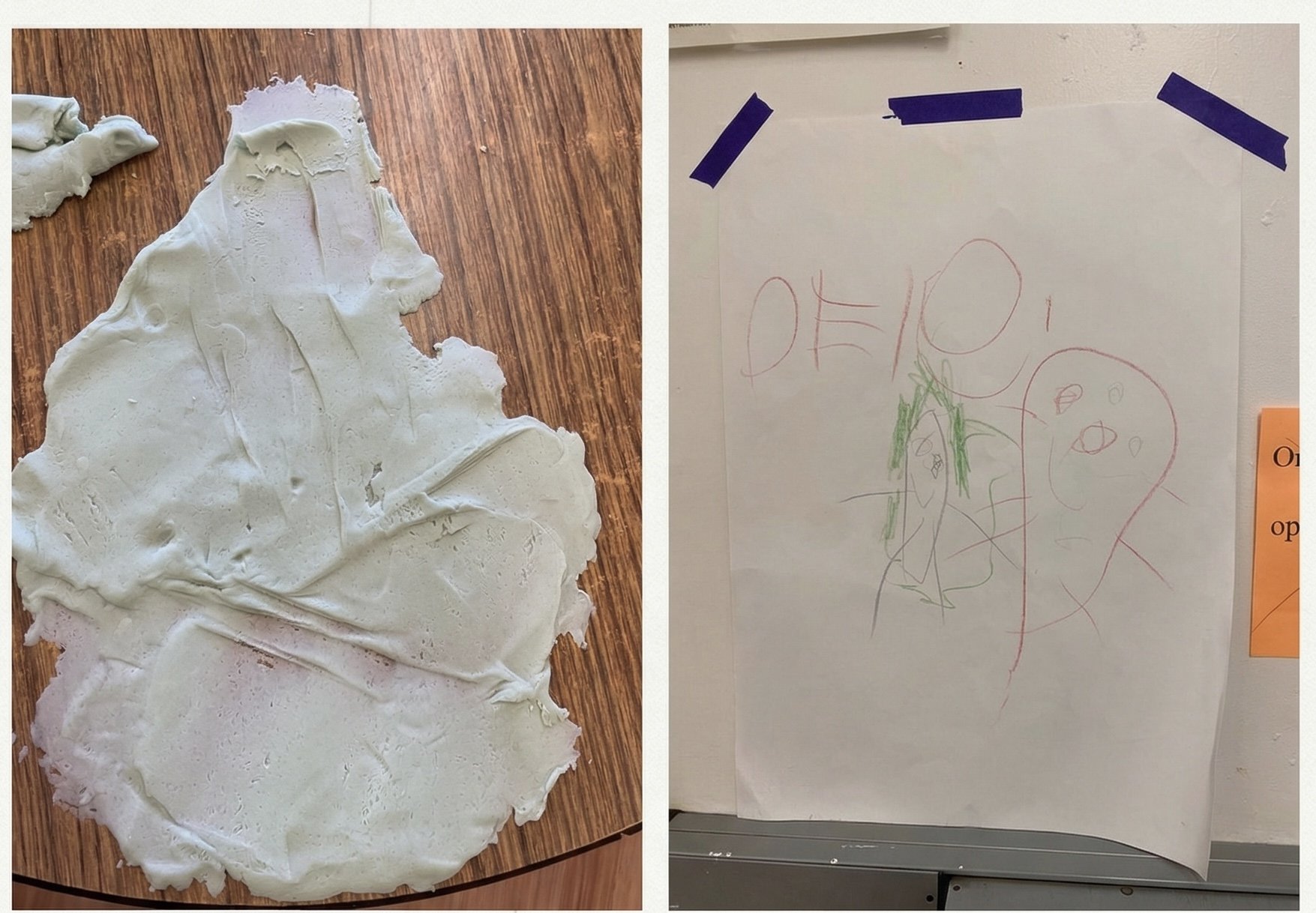
These questions shift the focus back to the child, encouraging them to visualize and problem solve on their own. When adults create an example, children often try to copy it, and might feel frustrated if their version doesn’t look the same. There is no “wrong” way to draw a dinosaur - it can have 7 legs (all different lengths), triangle shaped body, different shaped eyes - it’s their version.
Supporting Without taking Over - If a child seems unsure where to start, gentle guidance can help:
“Do you want the body for the dinosaur to be round or oval?”
“Dinosaurs have small ears. Where do you think the ears should go?”
You can also bring out dinosaur books to look at the images. This approach provides support without taking control, giving the child the tools to make their own creative choices.
Celebrating Their Unique Creations - Once the child finishes their drawing, focus on their effort and ideas rather than the accuracy of the image:
“I see you made a tall dinosaur. It looks like it can reach really high places!”
“You worked so hard on this dinosaur.”
“Look at all the details you added! Tell me more about it!”
By allowing children to create their own version of a dinosaur - whether it has 8 legs, or a swirl for a tail - we honor their unique perspective.
When a child asks, “Will you draw it for me?” try encouraging them to create their own. The goal isn’t to produce realistic drawing, but to give children the freedom to explore, create, and trust their artistic instincts.