
Loose Parts, or, The Magic of Cardboard
The wider the range of possibilities we offer children, the more intense will be their motivations and the richer their experiences. We must widen the range of topics and goals, the types of materials, and the possible interactions with things, peers, and adults.
- Loris Malaguzzi (Edwards, Gandini, & Forman, The Hundred Languages of Children, 3rd ed., 2012, p. 54)
When I was taking my practicum class (a supervised teaching experience required before taking a lead role in a classroom), I brought a lot of loose parts for the children to use in the classroom. One particular day, I brought some large boxes and loose pieces of fabric. I remember my fellow student-teachers watching the children play, amazed at the creativity and expansiveness provided by a random cardboard box. This is the type of play we see every day at FPNS — expansive, creative, and deeply engaged.
What are Loose Parts?
Loose parts are materials that can be combined, used, moved, and manipulated in many ways. They are child-directed and can be used alone or in combination with other materials. The term loose parts was originally coined by Simon Nicholson, an architect who argued for the democratization of creative arts and architecture, and advocated for children to be involved in the design and creation of children's spaces (Nicholson, S., 1972). In reading about this topic, the phrase Loose Parts is most commonly used, though one well-known author on the topic suggests changing the name to "unstructured or unscripted materials." When playing with unstructured materials, children create meaning in the environment, inviting them to be the protagonist. The children are allowed to mold, shape, and change the environment to meet their needs.
“In any environment, both the degree of inventiveness and creativity, and the possibility of discovery, are directly proportional to the number and kind of variables in it.” (Nicholson, 1972, pg. 6)
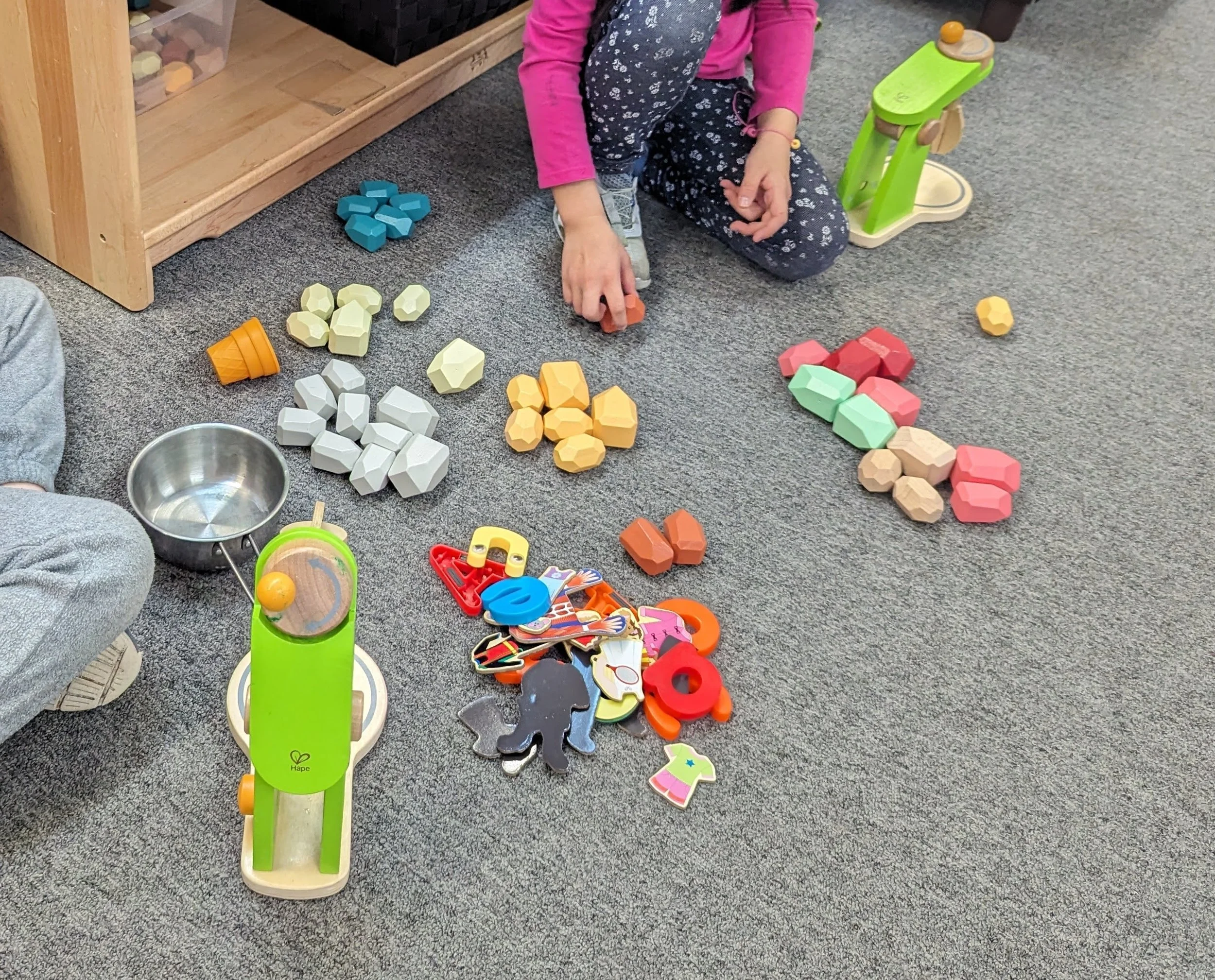
Loose parts help in many ways, including helping children:
develop inquiry skills and critical thinking,
learn to ask questions,
develop a wide range of developmental areas,
develop imagination, creativity, and divergent thinking,
develop social play and interaction,
promote active learning,
support developmental domains and the “5 selves,"
Loose parts are developmentally inclusive and promote a wide range of play (Daly and Beloglovsky, 2015; Haughey, 2017; Richards, 2020).
Loose Parts and Child Development
Child development theorist Jean Piaget theorized that children develop through several stages. The first stage, the sensorimotor stage, spans approximately the first two years of life and is characterized by the discovery of the world through exploration with the senses. Unstructured materials are a very sensory experience. They make unique noises, have a wide variety of textures, have interesting smells, and behave in intriguing ways.
The second stage, the preoperational stage, spans approximately ages 2 through 7, and is the time of life when children are learning symbolic representation — the idea that one thing can represent another. The idea that a rock can be a diamond, a treasure, a ball, a spoon, or anything else you can imagine is a critical step in pre-literacy. Children need to learn that one thing can represent another before they can learn that the text "rock" refers to the thing outside they were playing with, and that the form "A" represents a particular set of sounds. It is also an important pre-math step to understand that the numerals represent numbers, and that "+" means to add two groups together. In using loose parts, which have no defined purpose or goal, children can practice this skill and develop a deep understanding of symbolic representation.
Lev Vygotsky was another child development theorist. He theorized the Zone of Proximal Development (ZPD), which is the idea that children have a set of knowledge that can be expanded with the help of a more knowledgeable individual. By scaffolding with a more knowledgeable peer or an adult, children may be able to expand their own knowledge and understanding.
“Children learn most readily and easily in a laboratory-type environment where they can experiment, enjoy and find out things for themselves”. (Nicholson, 1972, pg. 8)
Loose Parts and 21st Century Skills
The 21st Century skills framework is a proposed framework of skills that is designed to support teachers in helping children learn the skills they will need to succeed in life and work in the modern world.
They include the following skills:
Creativity and Innovation
Think creatively
Work creatively with others
Implement innovations
Critical Thinking and Problem Solving
Use systems thinking
Reason effectively
Make judgements and decisions
solve problems
Communication and Collaboration
Communicate clearly
Collaborate with others
Information Literacy
Access and evaluate information
Use and manage information
Media Literacy
Analyze Media
Create media products
Information and Communications Technology Literacy (ICT Literacy)
Apply technology effectively
Flexibility and Adaptability
Adapt to change
Be flexible
Initiative and Self-Direction
Manage goals and time
Work independently
Be self-directed learners
Social and Cross-Cultural Skills
Interact effectively with others
Work effectively in diverse teams
Productivity and Accountability
Manage projects
Produce results
Leadership and Responsibility
Guide and lead others
Be responsible to others
While the use of unstructured materials does not directly touch on every one of the skills, the use of unstructured materials is a big support for many of the 21st-century skills.
Creativity, Innovation, Critical Thinking, and Problem Solving
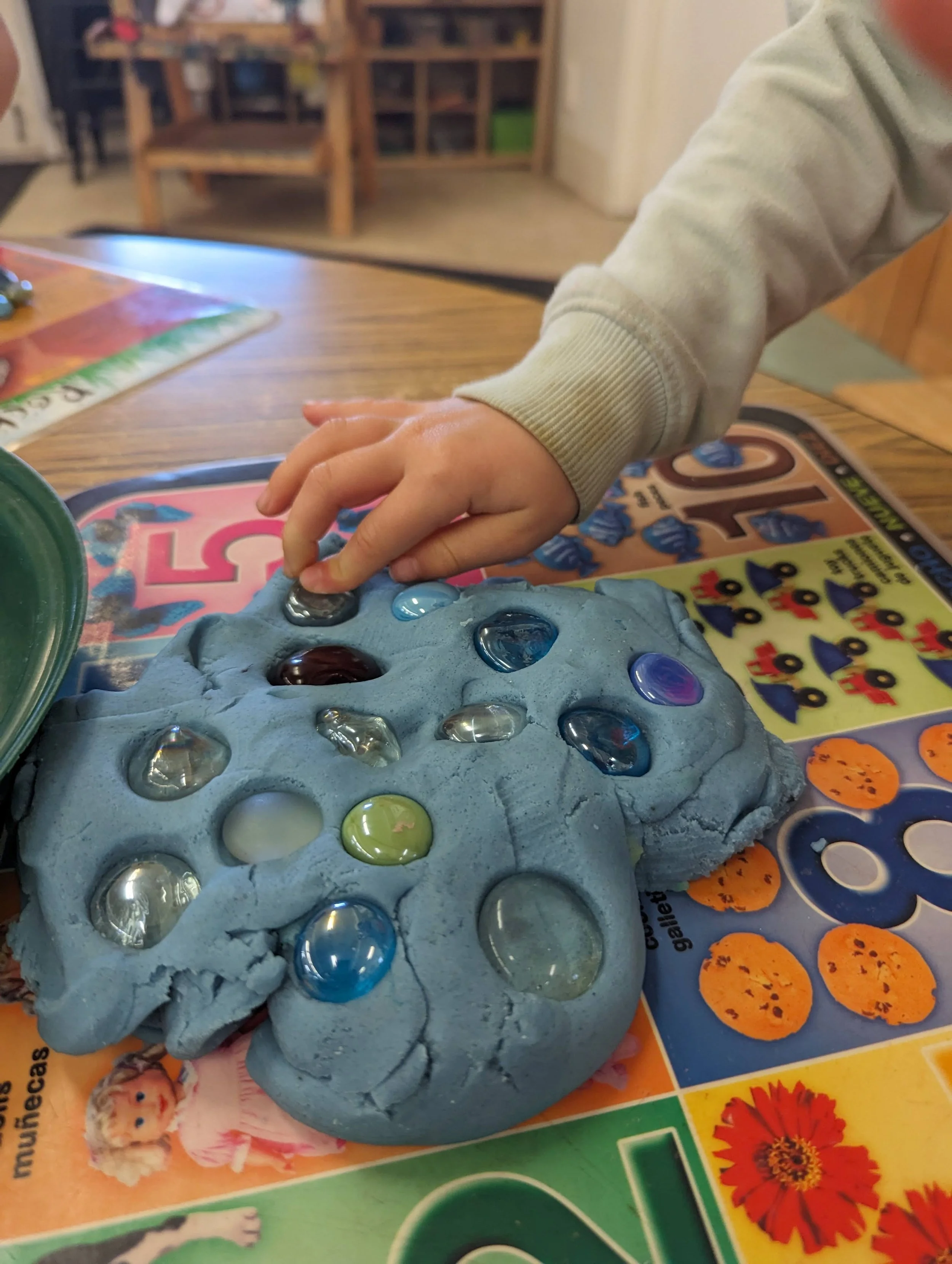
Using loose parts and unstructured materials requires children to think outside the box, think creatively, and innovate. These materials can be used in many ways and may be used for infinitely many different purposes in a single experience. They, by their very nature, invite creative uses and allow children to make the material what they need. This requires children to innovate, problem-solve, and find ways to use what they have.
Communication, Collaboration, Social, and Cross-Cultural Skills
Our school is very diverse, with people from many different cultures, children of different ages, and neurodiverse and neurotypical children all together in the same classroom. We often have 10 or more languages spoken at home in our small community. The children in our classroom must work together. Since loose parts are unspecific, children must practice communication with each other and help each other understand their own needs, wants, and hopes. When the children are making soup in the play kitchen and have toys shaped as potatoes, carrots, and onions, much less discussion needs to happen than when soup is being made from sand, rocks, leaves, and pine cones. The flexibility of the materials also requires the children to define their purpose, and they must make their purpose clear to their peers.
Flexibility and Adaptability
Because of the very flexible nature of unstructured materials, children learn early that what one person wants with that material may be different than what another wants with the same material. They also learn that while the rock was food for the dinosaurs yesterday, today it can be construction material, and tomorrow it might be something completely different. This teaches children the challenging skills of flexibility and adaptability.
Initiative and Self-Direction
Unstructured materials require children to take command of their own space and their own environment. The materials invite children to come up with and pursue their own ideas, instead of what the adults want from them. One child might be sorting the materials, while another is playing cooking, and yet another is practicing the transport schemata. Children come up with their own ideas and execute their plans.
Loose parts engage many parts of the brain and support children's learning, development, and future learning needs. They support learning for children with a variety of needs, at a variety of developmental stages, and support cognitive development for the whole child.
References
Daly, L., & Beloglovsky, M. (2015). Loose parts: Inspiring play in young children. Redleaf Press.
Daly, L., & Beloglovsky, M. (2016). Loose parts 2: Inspiring play with infants and toddlers (First edition). Redleaf Press.
Daly, L., & Beloglovsky, M. (2018). Loose parts 3: Inspiring culturally sustainable environments (First edition). Redleaf Press.
Daly, L., Beloglovsky, M., & Knight, J. (2019). Loose parts 4: Inspiring 21st-century learning (First edition). Redleaf Press.
Harvard University Graduate School of Education. (n.d.). 21st Century Learning: Battelle for Kids P21 Framework for 21st Century Skills. Harvard Education: Easel Lab. Retrieved September 14, 2026, from http://exploresel.gse.harvard.edu/frameworks/3/
Haughey, S. (2017). Playing with Loose Parts [Online Course]. Accessed February, 2023
Nicholson, S. (1971). How NOT to Cheat Children: The Theory of Loose Parts. Landscape Architecture, 62, 30–34.
Richards, E. (2020). Reflections: Learning Outdoors with Natural Loose Parts. Exchange.